Search across patient guides, museum chapters, lessons, study decks, cases and tools, or use a starting point above.
Patient guideEducation
Patients & curious visitors · Introductory
Evaluate biological dentistry, amalgam detox, root canals, cavitation surgery, ozone, material testing and ceramic implant claims.
Patient guideEducation
Patients & curious visitors · Introductory
Understand Phase 1 orthodontics, two-phase Class II treatment, growth and trainer claims, and the costs and follow-up questions to ask.
Patient guideEducation
Patients & curious visitors · Introductory
What palatal expansion can do, how sleep apnea is diagnosed, and how to assess airway scans, adult appliances and childhood prevention claims.
Patient guideEducation
Patients & curious visitors · Introductory
How different features of a bite reflect different influences, without a single-cause story.
Patient guideEducation
Patients & curious visitors · Introductory
Evaluate claims that tongue posture, jaw exercise or an appliance will reshape an adult face, grow jawbone or cure sleep apnea.
Patient guideEducation
Patients & curious visitors · Introductory
A patient guide to TMD: jaw joints, muscle pain, symptoms, overlapping conditions and factors associated with pain, with sources and optional deeper reading.
Patient guideEducation
Patients & curious visitors · Introductory
Separate infant feeding decisions from claims about speech, jaw growth, posture and sleep apnea. Understand tongue-tie release and myofunctional therapy.
Patient guideEducation
Patients & curious visitors · Introductory
A printable discussion guide for checking dental treatment claims, evidence, alternatives, irreversible changes, costs and follow-up.
Patient guideEducation
Patients & curious visitors · Introductory
Evolution, inheritance and development — and what they mean for your teeth.
Patient guideEducation
Patients & curious visitors · Introductory
The evidence about crowding, and the separate reasons a wisdom tooth might need treatment.
Guide collectionEducation
Patients & curious visitors · Introductory
Plain-language guides to teeth, growing jaws, TMD, sleep and dental treatment claims. Read the essentials or explore the evidence in more depth.
Museum collectionEducation
Everyone · Introductory
The deeper science behind orthodontics — anthropology, evolution, and the evidence behind facial change. Educational content from OrthoTruss.
Museum collectionEducation
Everyone · Introductory
Explore historical studies of proportion, the human skull, and the classical canon through the OrthoTruss museum collection.
Museum collectionEducation
Everyone · Introductory
A tour of how humans theorized, measured, and mis-measured the face, from Egyptian canons to the machine gaze.
Museum chapterEducation
Everyone · Deeper reading
Hominin arc, cooking, self-domestication, and the chin puzzle.
Museum chapterEducation
Everyone · Deeper reading
Clinal variation, not types.
Museum chapterEducation
Everyone · Deeper reading
The neuroscience and psychology of face perception.
Museum chapterEducation
Everyone · Deeper reading
AI physiognomy: the old mistake, automated.
Museum chapterEducation
Everyone · Deeper reading
Egypt, Polykleitos, Vitruvius, Leonardo, Dürer, and the golden-ratio myth.
Museum chapterEducation
Everyone · Deeper reading
Physiognomy, craniometry, and the invented science of faces.
Museum chapterEducation
Everyone · Deeper reading
The modern jaw epidemic and what the evidence supports.
Museum chapterEducation
Everyone · Deeper reading
Boas 1912 and the cephalic-index collapse.
Museum chapterEducation
Everyone · Deeper reading
The history of physiognomy and craniometry, and the harm it did.
Museum chapterEducation
Everyone · Deeper reading
Why only modern humans have a prominent chin — and why no one explanation has held.
Museum chapterEducation
Everyone · Deeper reading
Automated physiognomy from Galton's composites to neural nets.
Museum chapterEducation
Everyone · Deeper reading
Price, Corruccini, and the modern malocclusion question.
Museum chapterEducation
Everyone · Deeper reading
Boas 1912 and the re-analysis war that still isn't settled.
History essayEducation
Everyone · Introductory
The history orthodontics tells about itself is tidy. The real one is a story of founders, fights, suppressed dissent, and questions still unsettled — with the people conventional accounts leave out put back.
Biology chapterEducation
Learners & clinicians · Foundations & reference
At birth, the skull and face grow at wildly different rates — the head that looks "too big" for the face is not a proportion error, it is the plan. This chapter follows the skull and jaws from that first mismatch through to the adult proportions orthodontics is built to understand.
Biology chapterEducation
Learners & clinicians · Foundations & reference
An archwire doesn't move a tooth directly — it moves the periodontal ligament, and the ligament tells the bone what to do. This chapter follows that chain: from the fibrous tissue holding a tooth in its socket, to the pressure and tension it feels under load, to the cells and molecular signal that turn "squeezed" into "resorbed" and "stretched" into "built."
Biology chapterEducation
Learners & clinicians · Foundations & reference
Long before a tooth appears in the mouth, it is already moving. This chapter follows that hidden journey: from a crown sitting quietly in its bony crypt, to a root that elongates and drags it upward, to the same resorb-here/build-there bone machinery from the last chapter now working vertically instead of sideways, to the preformed path it follows through bone, and to what happens when any link in that chain breaks.
Biology chapterEducation
Learners & clinicians · Foundations & reference
Every mechanism in the last two chapters can fail in a specific, recognizable way. A blocked path stalls a tooth in impaction. The follicle that clears bone can instead trap fluid and become a cyst. A ligament that never regenerates after injury lets bone fuse directly onto root, freezing a tooth in place. And a primary tooth's own exfoliation depends on the same resorption machinery being aimed at its root instead of bone. This chapter follows each failure back to the normal process it broke.
CourseEducation
Learners & clinicians · Foundations & reference
Force systems, centers of resistance, anchorage, wire mechanics, and loop mechanics.
CourseEducation
Learners & clinicians · Foundations & reference
Cephalometric, facial, occlusal, and problem-list reasoning for treatment planning.
CourseEducation
Learners & clinicians · Foundations & reference
Craniofacial growth, skeletal maturation, dental development, and growth modification.
CourseEducation
Learners & clinicians · Foundations & reference
Orthodontic wires, brackets, adhesives, and aligner materials.
Clinical roundEducation
Learners & clinicians · Applied mechanics
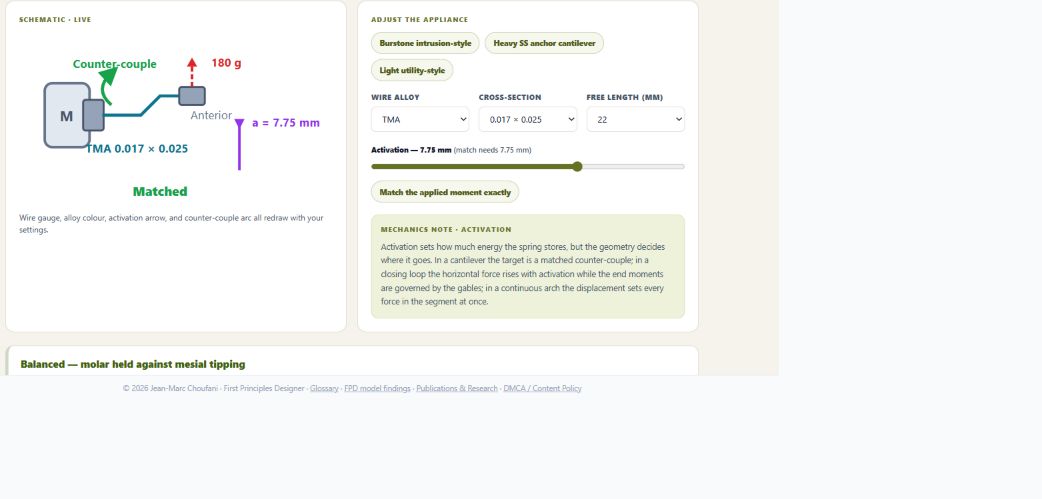
Retract the anterior segment without allowing the posterior unit to tip mesially.
Clinical roundEducation
Learners & clinicians · Applied mechanics
Use differential end moments for space closure while controlling the vertical response at both teeth.
Clinical roundEducation
Learners & clinicians · Applied mechanics
Intrude the occlusally displaced mandibular right canine 43 while identifying the initial force, moment, and reciprocal response on each connected tooth.
Clinical roundEducation
Learners & clinicians · Applied mechanics
Move the crown first while keeping the initial tipping response controlled.
Clinical roundEducation
Learners & clinicians · Applied mechanics
Move crown and root together initially instead of accepting a crown-first response.
Clinical roundEducation
Learners & clinicians · Applied mechanics
Increase root control until the root leads the initial response.
Clinical roundEducation
Learners & clinicians · Applied mechanics
Reverse the direction of translation without losing the signed force-and-couple relationship.
Clinical scenarioEducation
Learners & clinicians · Applied mechanics
Close extraction spaces by retracting the anterior segment while preventing mesial molar migration and maintaining lower incisor inclination.
Clinical scenarioEducation
Learners & clinicians · Applied mechanics
Retract the maxillary anterior segment to reduce overjet (Class II camouflage / dentoalveolar protrusion) while maintaining upper incisor torque and preventing mesial migration of the maxillary molars.
Clinical scenarioEducation
Learners & clinicians · Applied mechanics
Coordinate maximum-anchorage retraction of both arches to reduce bimaxillary dentoalveolar protrusion and improve the lip profile, keeping upper/lower retraction balanced so the molar relationship stays Class I and the midlines coincident.
Clinical scenarioEducation
Learners & clinicians · Applied mechanics
Shift the upper anterior segment toward the deviated side to correct the dental midline, using differential left-vs-right anchorage and asymmetric force systems while avoiding a new posterior or molar asymmetry.
Clinical scenarioEducation
Learners & clinicians · Applied mechanics
Retract and retrocline the lower anterior segment (and often procline the uppers) to correct the incisor relationship and camouflage a mild-to-moderate skeletal Class III, staying inside the lower-incisor inclination limit set by the labial alveolar bone.
Clinical scenarioEducation
Learners & clinicians · Applied mechanics
Relieve lower crowding / retract the lower labial segment using lower-only premolar extraction, while planning the lower anchorage so the buccal occlusion finishes in an agreed relationship despite the unmatched upper arch.
Clinical scenarioEducation
Learners & clinicians · Applied mechanics
Close the second-premolar extraction spaces mainly by mesial movement (protraction) of the posterior segments, preserving incisor position in a minimum/moderate-anchorage case where little anterior retraction is wanted.
Clinical scenarioEducation
Learners & clinicians · Applied mechanics
Close the edentulous molar space by protracting the posterior teeth forward into the site while a contralateral compensating extraction balances the arch, keeping the midline centred and the occlusal plane level despite the built-in left-right asymmetry.
SimulatorFPD
Clinicians & researchers · Applied mechanics
Compare posterior drift before choosing whether added teeth or skeletal anchorage are needed.
SimulatorFPD
Clinicians & researchers · Applied mechanics
Choose activation and inspect the molar counter-moment, reciprocal force, and tube-friction effect.
SimulatorFPD
Clinicians & researchers · Applied mechanics
Compare loop height, position, wire, and gable bends at both teeth before engagement.
SimulatorFPD
Clinicians & researchers · Applied mechanics
Build the force and counter-couple, then inspect the intended response and reciprocal load in 3D.
SimulatorFPD
Clinicians & researchers · Applied mechanics
See whether the wire is active and which tooth receives each force and couple.
SimulatorFPD
Clinicians & researchers · Applied mechanics
Level one displaced tooth and reveal the reciprocal extrusion and moments inherited by its neighbors.
SimulatorFPD
Clinicians & researchers · Applied mechanics
Estimate how much prescribed force reaches the tooth after friction and binding.
SimulatorFPD
Clinicians & researchers · Applied mechanics
Displace a tooth, engage a wire, and inspect the initial load delivered across the arch.
SimulatorFPD
Clinicians & researchers · Applied mechanics
Compose wires, elastics, and skeletal anchorage, then attribute the superposed response tooth by tooth.
SimulatorFPD
Clinicians & researchers · Applied mechanics
Compare bare-aligner expression with reduced-order attachment alternatives.
Research toolFPD
Clinicians & researchers · Advanced
Run tensile, bend, fatigue, and custom-geometry tests from a cited property database.
Research toolFPD
Clinicians & researchers · Advanced
Define or fit a superelastic alloy and run a virtual test modeled after ISO 15841.
Research toolFPD
Clinicians & researchers · Advanced
Generate a reference-solver dataset and watch an in-browser surrogate approximate it.
Research toolFPD
Clinicians & researchers · Advanced
Propagate wire and slot tolerances into engagement-play distributions and capability estimates.
Research toolFPD
Clinicians & researchers · Advanced
Propagate input ranges to output intervals and rank the modeled sources of variance.
Study deckEducation
Learners & clinicians · Professional study
M/F Ratio & Force Systems questions for study and self-testing. Coverage is selective; sources are shown with the answers.
Study deckEducation
Learners & clinicians · Professional study
Force Systems questions for study and self-testing. Coverage is selective; sources are shown with the answers.
Study deckEducation
Learners & clinicians · Professional study
Center of Resistance & Rotation questions for study and self-testing. Coverage is selective; sources are shown with the answers.
Study deckEducation
Learners & clinicians · Professional study
Anchorage questions for study and self-testing. Coverage is selective; sources are shown with the answers.
Study deckEducation
Learners & clinicians · Professional study
Wire Mechanics questions for study and self-testing. Coverage is selective; sources are shown with the answers.
Study deckEducation
Learners & clinicians · Professional study
Loop Mechanics questions for study and self-testing. Coverage is selective; sources are shown with the answers.
Study deckEducation
Learners & clinicians · Professional study
Class I Malocclusion questions for study and self-testing. Coverage is selective; sources are shown with the answers.
Study deckEducation
Learners & clinicians · Professional study
Class II Malocclusion questions for study and self-testing. Coverage is selective; sources are shown with the answers.
Study deckEducation
Learners & clinicians · Professional study
Class III Malocclusion questions for study and self-testing. Coverage is selective; sources are shown with the answers.
Study deckEducation
Learners & clinicians · Professional study
Open Bite questions for study and self-testing. Coverage is selective; sources are shown with the answers.
Study deckEducation
Learners & clinicians · Professional study
Deep Bite questions for study and self-testing. Coverage is selective; sources are shown with the answers.
Study deckEducation
Learners & clinicians · Professional study
Transverse Discrepancies questions for study and self-testing. Coverage is selective; sources are shown with the answers.
Study deckEducation
Learners & clinicians · Professional study
Craniofacial Growth questions for study and self-testing. Coverage is selective; sources are shown with the answers.
Study deckEducation
Learners & clinicians · Professional study
Skeletal Growth questions for study and self-testing. Coverage is selective; sources are shown with the answers.
Study deckEducation
Learners & clinicians · Professional study
Dental Development questions for study and self-testing. Coverage is selective; sources are shown with the answers.
Study deckEducation
Learners & clinicians · Professional study
Growth Modification questions for study and self-testing. Coverage is selective; sources are shown with the answers.
Study deckEducation
Learners & clinicians · Professional study
Growth Assessment & Cephalometry questions for study and self-testing. Coverage is selective; sources are shown with the answers.
Study deckEducation
Learners & clinicians · Professional study
Facial Form & Growth Assessment questions for study and self-testing. Coverage is selective; sources are shown with the answers.
Study deckEducation
Learners & clinicians · Professional study
Occlusal Findings & Dental Compensation questions for study and self-testing. Coverage is selective; sources are shown with the answers.
Study deckEducation
Learners & clinicians · Professional study
Problem List & Treatment Objectives questions for study and self-testing. Coverage is selective; sources are shown with the answers.
Study deckEducation
Learners & clinicians · Professional study
Fixed Appliances & Functional–Fixed Protocols questions for study and self-testing. Coverage is selective; sources are shown with the answers.
Study deckEducation
Learners & clinicians · Professional study
Aligner Mechanics questions for study and self-testing. Coverage is selective; sources are shown with the answers.
Study deckEducation
Learners & clinicians · Professional study
Orthopedic Appliances questions for study and self-testing. Coverage is selective; sources are shown with the answers.
Study deckEducation
Learners & clinicians · Professional study
Retention & Relapse questions for study and self-testing. Coverage is selective; sources are shown with the answers.
Study deckEducation
Learners & clinicians · Professional study
Orthodontic Wires questions for study and self-testing. Coverage is selective; sources are shown with the answers.
Study deckEducation
Learners & clinicians · Professional study
Brackets & Slots questions for study and self-testing. Coverage is selective; sources are shown with the answers.
Study deckEducation
Learners & clinicians · Professional study
Bonding & Adhesives questions for study and self-testing. Coverage is selective; sources are shown with the answers.
Study deckEducation
Learners & clinicians · Professional study
Aligner Materials questions for study and self-testing. Coverage is selective; sources are shown with the answers.
Study deckEducation
Learners & clinicians · Professional study
Class II Case Questions questions for study and self-testing. Coverage is selective; sources are shown with the answers.
Study deckEducation
Learners & clinicians · Professional study
Class III Case Questions questions for study and self-testing. Coverage is selective; sources are shown with the answers.
Study deckEducation
Learners & clinicians · Professional study
Extraction Decisions & Tissue Response questions for study and self-testing. Coverage is selective; sources are shown with the answers.
Study deckEducation
Learners & clinicians · Professional study
Non-Extraction Decisions questions for study and self-testing. Coverage is selective; sources are shown with the answers.
Study deckEducation
Learners & clinicians · Professional study
Periodontal Tissues & Tooth Movement questions for study and self-testing. Coverage is selective; sources are shown with the answers.
Study deckEducation
Learners & clinicians · Professional study
Surgical Orthodontics questions for study and self-testing. Coverage is selective; sources are shown with the answers.
Study deckEducation
Learners & clinicians · Professional study
Interdisciplinary Treatment questions for study and self-testing. Coverage is selective; sources are shown with the answers.
Literature toolEducation
Clinicians & researchers · Foundations & reference
Check a saved query and its filters for papers you have not marked seen.
Literature toolEducation
Clinicians & researchers · Foundations & reference
Organize papers by question, export citations, and back up papers, lists and watches.
UtilityFPD
Clinicians & researchers · Foundations & reference
Estimate raw-metal cost exposure using the latest available source values and clearly labeled fallbacks.
UtilityEducation
Clinicians & researchers · Foundations & reference
Browse a daily journal roundup, search Europe PMC across all years, and follow article links to their source.
UtilityEducation
Clinicians & researchers · Foundations & reference
Open your saved papers, watch topics, and study resources in this browser without an account.
UtilityFPD
Clinicians & researchers · Foundations & reference
Pin two simulator states and compare their parameters, outputs, and signed differences.
ReferenceEducation
Learners & clinicians · Foundations & reference
Look up the terms used in the lessons and instruments.
No resources match these filters. Try a broader term or clear the filters. To search published papers, open Library & evidence.
 OrthoTruss