Case and consequence
See the appliance and objective, then commit to the side effect that matters before anything is engaged.
 OrthoTruss™
Work from a clinical objective to the complete initial force system: intended response, reciprocal load, and the adjustment most likely to matter before activation.
Educational and research tool, not a medical device. Outputs describe the initial mechanical tendency, not a patient-specific treatment forecast.
A 30-second mechanics check
A 180 g force acts 8 mm from the center of resistance.
Choose before engaging
What should the posterior counter-couple do?
Select a simplified moment balance and inspect the remaining rotational tendency.
Simplified moment balance only. The Bench also exposes reciprocal force, contact, friction, and model assumptions.
FPD is the biomechanics workspace. Find the surrounding lessons, study materials and external literature through Education.
Bring biology, clinical cases and related instruments together around one question.
Explore topics → Study & self-testOpen study decks, self-directed courses and practice exams. Continue your existing progress.
Open study resources → Library & evidenceSearch published papers, revisit your saved library and check watch topics.
Open literature tools →Seven clinical rounds cover posterior anchorage, closing-loop control, continuous-arch effects, controlled tipping, translation, root movement, and reversed-force design. Each one carries into the Bench.
See the appliance and objective, then commit to the side effect that matters before anything is engaged.
Reveal the intended response and reciprocal cost, then change one clinically meaningful variable.
Carry the same case into the full instrument without losing its force-system context.
The clinical rounds, interactive Bench, and research tools are different depths of the same biomechanics environment—not disconnected products.
Clinical decisions first. Seven short cases: adjust one chairside variable, see the consequence, then continue in the Bench.
Open Clinical Rounds Biomechanics BenchTen tools. Build the initial force system and read its moments, centers, reactions, and reciprocal loads.
Open the Bench Research LabLearn and investigate with five tools for sensitivity, materials, tolerance, and uncertainty, the evidence boundary visible.
Open the Research LabSelected capabilities
These examples show the range without turning this page into a tool directory. Start with the clinical question that resembles yours; the complete collection remains one click away.
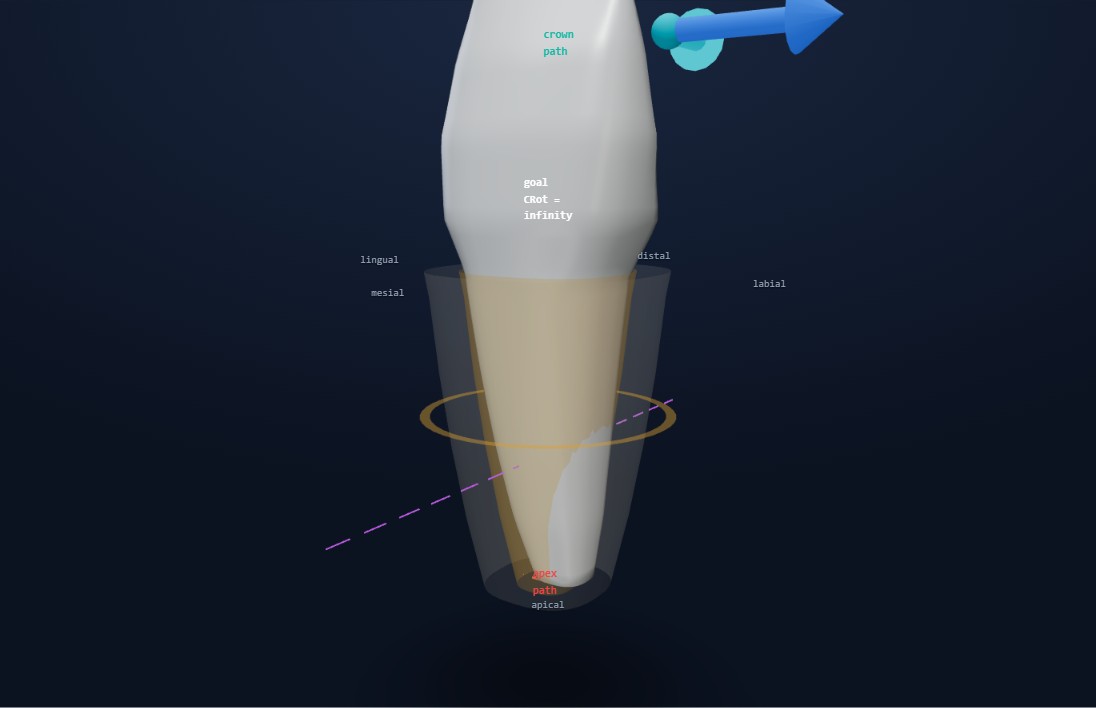
What complete initial force system produces the intended movement, and where do the reactions go?
Build the force and counter-couple, then inspect the intended response and reciprocal load in 3D.
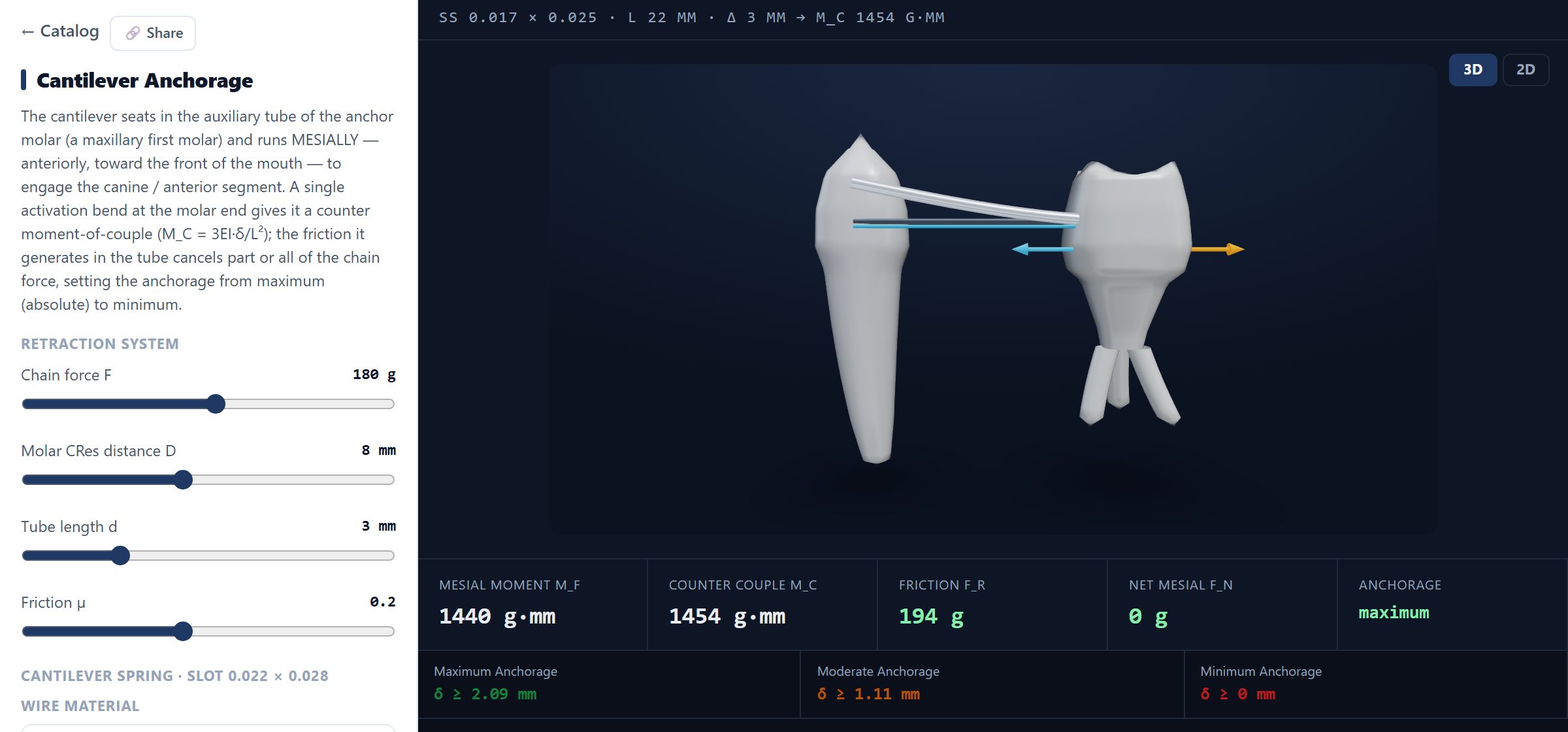
Will this cantilever retract the anterior segment without tipping the posterior unit mesially?
Choose activation and inspect the molar counter-moment, reciprocal force, and tube-friction effect.
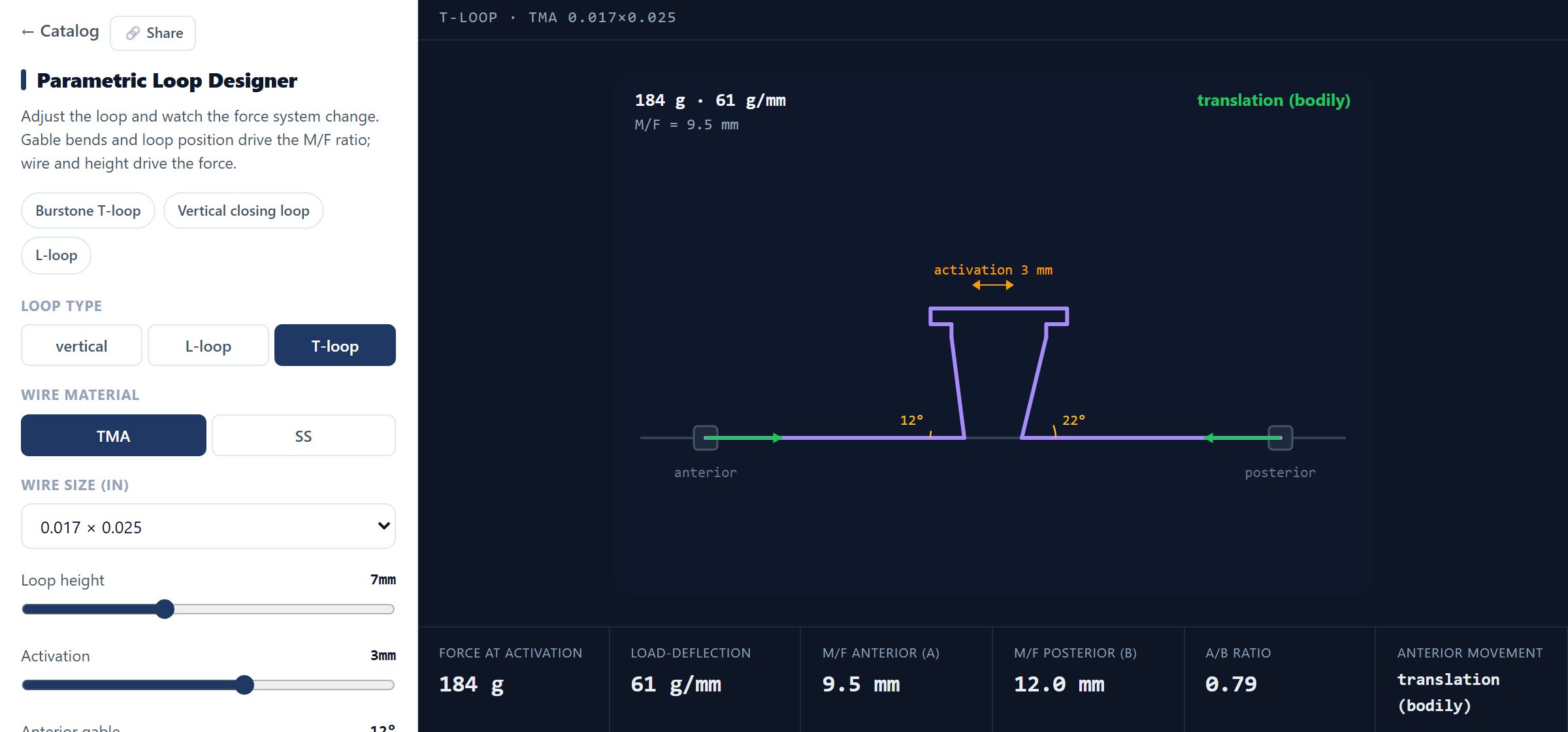
Which loop design closes the space while controlling the vertical and rotational side effects?
Compare loop height, position, wire, and gable bends at both teeth before engagement.
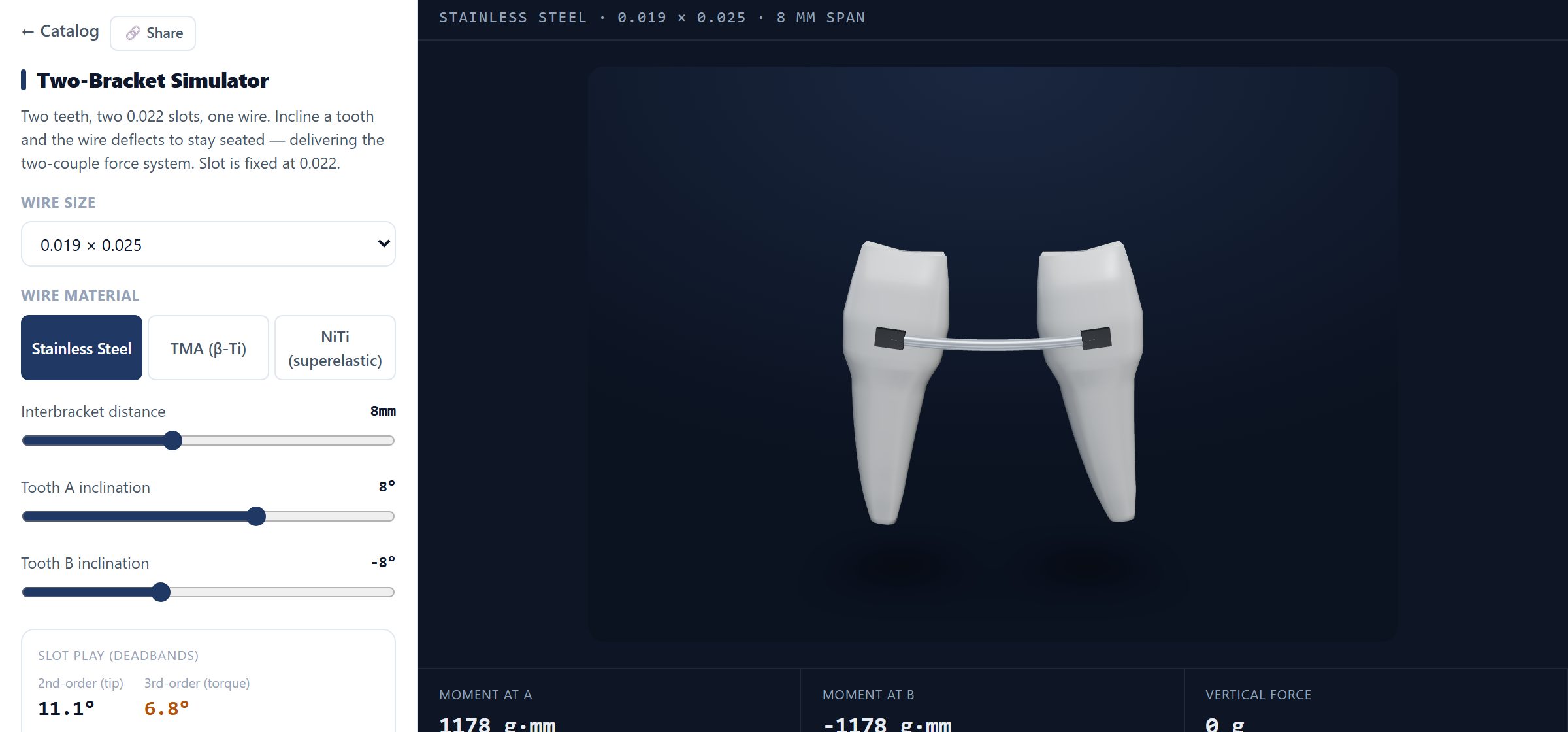
What does this wire deliver to each bracket after slot play, span, size, and inclination are considered?
See whether the wire is active and which tooth receives each force and couple.
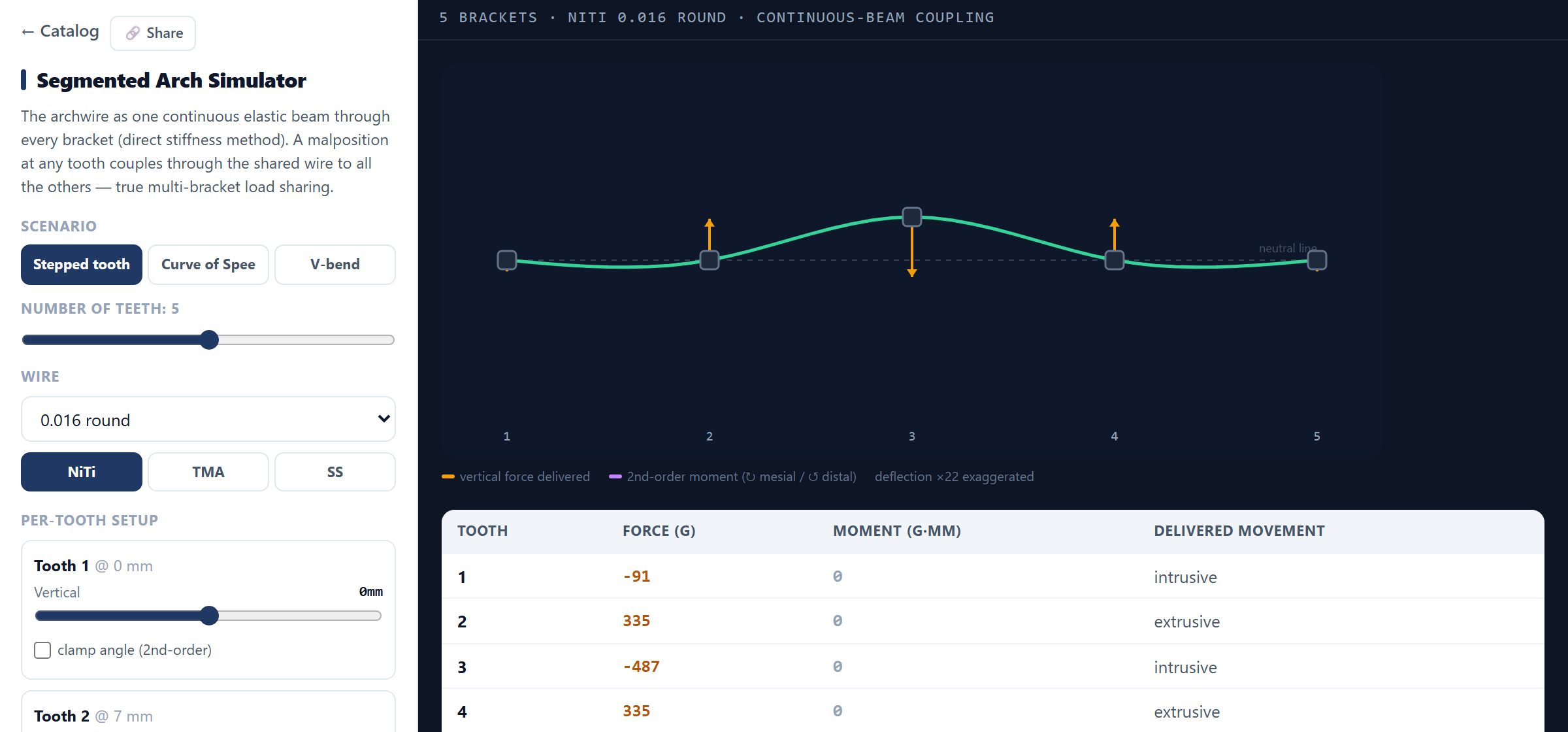
Which neighboring teeth inherit the reaction when this tooth is leveled through a continuous arch?
Level one displaced tooth and reveal the reciprocal extrusion and moments inherited by its neighbors.
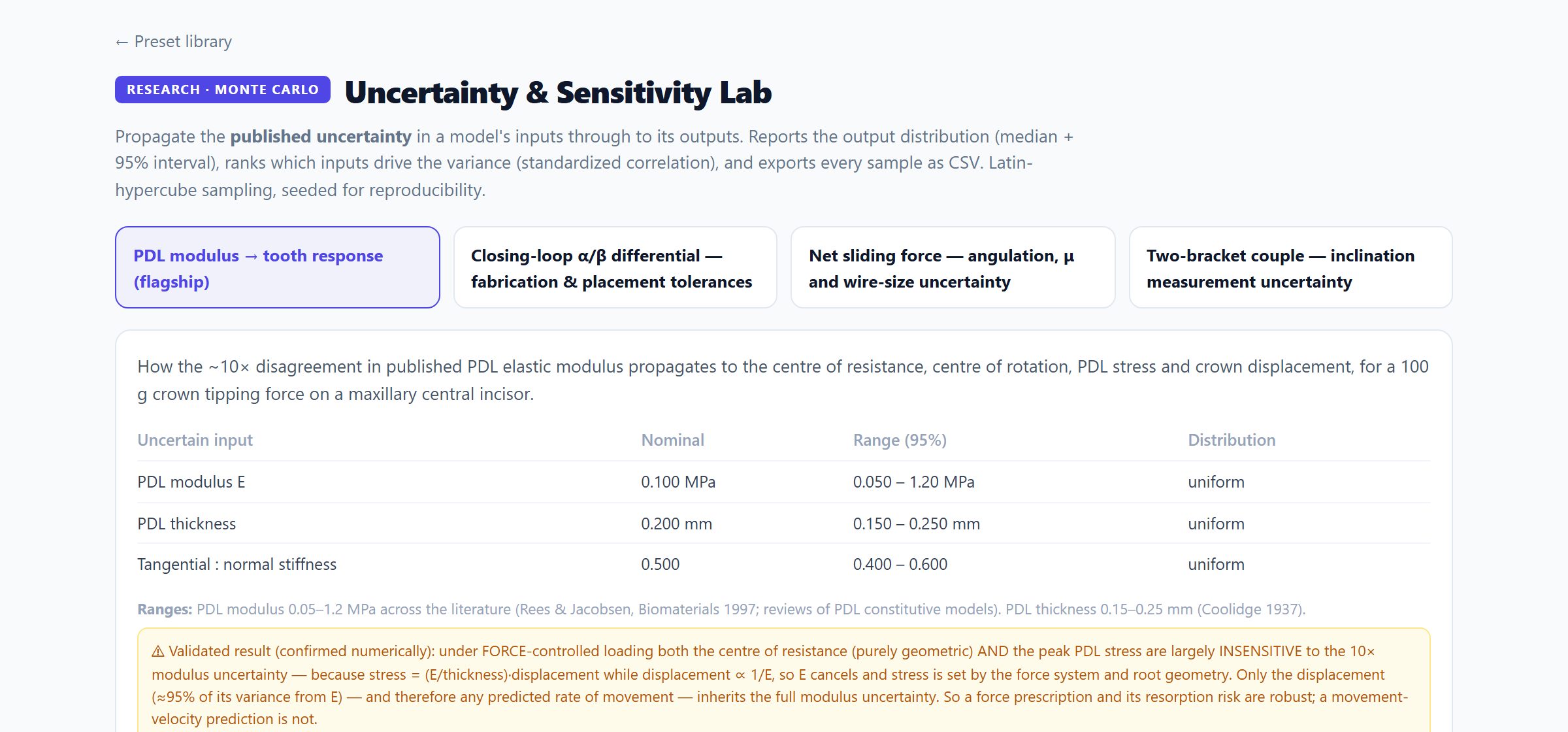
Which assumptions drive the modeled result, and how wide is the resulting uncertainty interval?
Propagate input ranges to output intervals and rank the modeled sources of variance.
Every tool keeps its model class, assumptions, and evidence boundary visible near the result.
Force-system outputs describe the initial mechanical response, not a patient-specific treatment forecast.
Works with no account or paid plan required. Learning progress and workspace notes stay on this device.
Analytical, benchmarked, literature-calibrated, reference-data, and exploratory models are labeled distinctly.
Choose the consequence, see the full initial force system, adjust one variable, and continue in the Bench.
Start a clinical round