What the anthropology shows
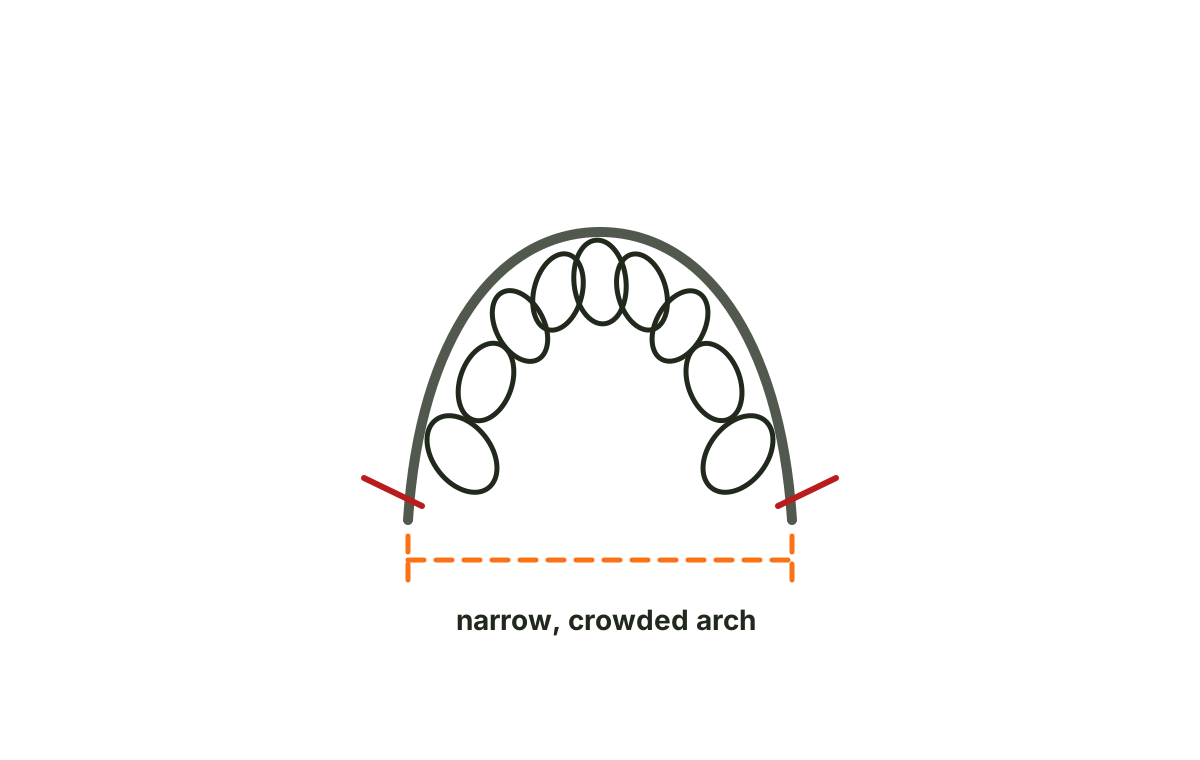
Here is the real kernel inside the "modern diet" story, and it is genuinely fascinating. When anthropologists compare the teeth of hunter-gatherers, early farmers, and industrial populations, crowding and bite problems tend to become more common as diets get softer and more processed. In 1984 the biological anthropologist Robert Corruccini described this as an epidemiologic transition in dental occlusion: as communities urbanize and industrialize, malocclusion rises along the same curve that drives up rates of diabetes and heart disease.10 The leading explanation is mechanical: tougher, less processed food demands far more chewing during childhood, and the jaw, like other bones, grows in response to the loads placed on it while it is developing. Less chewing stress, the argument goes, means a slightly smaller, less fully expanded jaw, with less room for a full set of teeth.
The most direct skeletal support came in 2011, when Noreen von Cramon-Taubadel compared jaw shape across hunter-gatherer and farming populations worldwide and found that, unlike the rest of the skull (whose shape mostly tracks ancestry), the lower jaw tracked subsistence: tougher-diet groups had consistently longer, narrower jaws than softer-diet groups.11 It is a real, striking pattern. But two honest caveats keep it from becoming the whole story. Evidence has limits. The forager-to-industrial direction is well established, but the 'farming' leg is regionally inconsistent (some sequences show little effect until the industrial era), and the field's own largest quantitative-genetics analysis found diet-consistent effects modest relative to neutral genetic drift and population history. Bones show association, not proof of cause for any individual. Katz, Grote & Weaver 2017, PNAS; Corruccini 1984, Am J Orthod First, the effect is not identical everywhere it has been studied, and the field's own largest genetic analysis describes the diet contribution as real but modest next to ancestry and population history, not the dominant force.12 Second, skeletal remains can show a strong association between diet and jaw shape, but bones alone cannot prove that diet, rather than genetics or population movement, caused any one change.
There is an older, elegant version of this idea worth restoring, because it is usually reduced to a footnote. In the 1950s the Australian orthodontist Raymond Begg, studying the heavily worn teeth of Aboriginal Australians, argued that ancient abrasive diets wore teeth down at the sides as well as the tops, creating space that prevented crowding, his "attritional occlusion" theory.13 It captured something real about ancient dentitions. But Corruccini himself later tested and revised the specific mechanism,14 and the modern reading has shifted from "our teeth are too big and unworn" toward "our jaws are a little too small" as the more important half of the equation, a question our history of orthodontics follows in more detail. Evidence has limits. The modern review confirms ancient wear reshaped dentitions, but the clinically important claim that lost wear is a major driver of modern crowding is explicitly flagged as needing further investigation; Corruccini's own test found tooth length did not correlate with crowding, reframing it toward jaw size. Genuinely open, not settled. Corruccini 1990, AJODO; Begg 1954, Am J Orthod Begg's real value is not the specific answer but the method: a clinician reasoning from first principles about deep human history, and honestly updating when the evidence pushed back.
 OrthoTruss