 OrthoTruss™
OrthoTruss™
OrthoTruss™
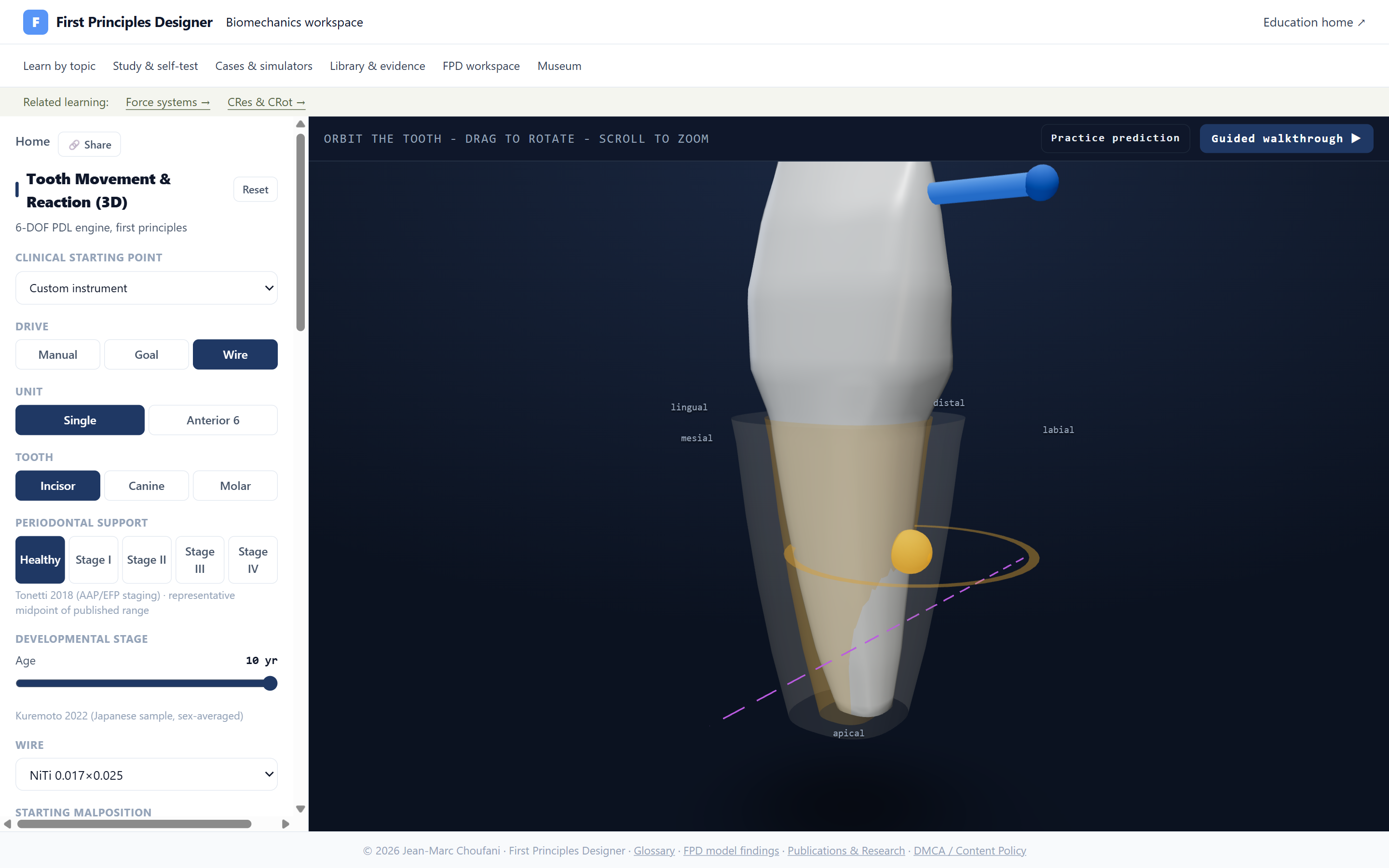
Inspect a tooth under an initial force system through a benchmarked population-reference model. See the center of resistance, center of rotation, crown and apex tendencies, and modeled PDL load distribution. Compare tipping, translation, and root-directed movement without treating the result as a patient forecast.
No install · No signup · Runs in your browser. Educational and research tool — not a medical device.
Model assumptions, cited relationships, and source-backed inputs are exposed so derived outputs can be interpreted within scope.
Located for any root geometry — the point where a single force gives pure translation. See it shift as the root changes.
Watch it migrate as you change the moment-to-force ratio — from tipping, to controlled tipping, to bodily movement and root torque.
Dial the moment-to-force ratio and see the movement type resolve live — the core of orthodontic force-system design.
Per-patch periodontal-ligament stress against the optimal-pressure threshold — see where the ligament is overloaded.
A mechanical indicator from the reference PDL field shows where a selected force system concentrates load. It does not predict patient-specific resorption.
Trace the modeled initial crown and root-apex paths implied by the selected reference force system.
From a force system to a moving tooth in three steps — no setup.
Choose the force, the moment, and the appliance — or start from a preset. A bracket-applied force with a chosen M/F ratio.
The benchmarked PDL model applies the load, estimates initial ligament displacement, and recomputes as the modeled force decays.
Play or scrub through the model and read CRes, CRot, load distribution, and crown/apex paths at every step.
The population-reference model is checked against defined analytical and literature reference cases, including center-of-resistance and M/F-to-center-of-rotation behavior. Those checks support conceptual mechanics; they are not external clinical validation or patient-specific prediction.
Biomechanics is abstract on paper. This makes it something you can change and watch.
Build intuition for force systems before the clinic. See why a moment changes the movement, instead of memorizing M/F ratios.
A fast sandbox to reason about force systems, tipping, and modeled load concentration — concept-level, never patient-specific.
A transparent teaching and research model with cited relationships, exposed assumptions, and model-dependent outputs; the engine is available as a citable library.
The center of resistance is the point at which a single force produces pure translation (bodily movement) with no rotation. For a single-rooted tooth it sits roughly 40% of the root length apical to the alveolar crest. The simulator locates it for any root geometry and shows how it shifts.
The moment-to-force ratio helps determine the initial center of rotation, but the transition values depend on root geometry, support, center-of-resistance location, and point of force application. Translation occurs when M/F approaches the effective lever arm for the selected reference geometry; the simulator shows that relationship as inputs change.
It's at no cost, with no signup, and runs entirely in your browser — nothing is downloaded or installed.
No. It is an educational and research simulation of general biomechanics using generic, user-entered parameters. It does not use patient data and is not intended for the diagnosis or treatment planning of individual patients.
A benchmarked periodontal-ligament / rigid-body population-reference model in the Ortho-Biomechanics engine. Key assumptions and cited relationships are exposed, but the model has not been clinically validated for individual prediction.
No cost, in your browser, right now. Change a force, watch the mechanics respond.
Launch the Tooth-Movement Simulator →